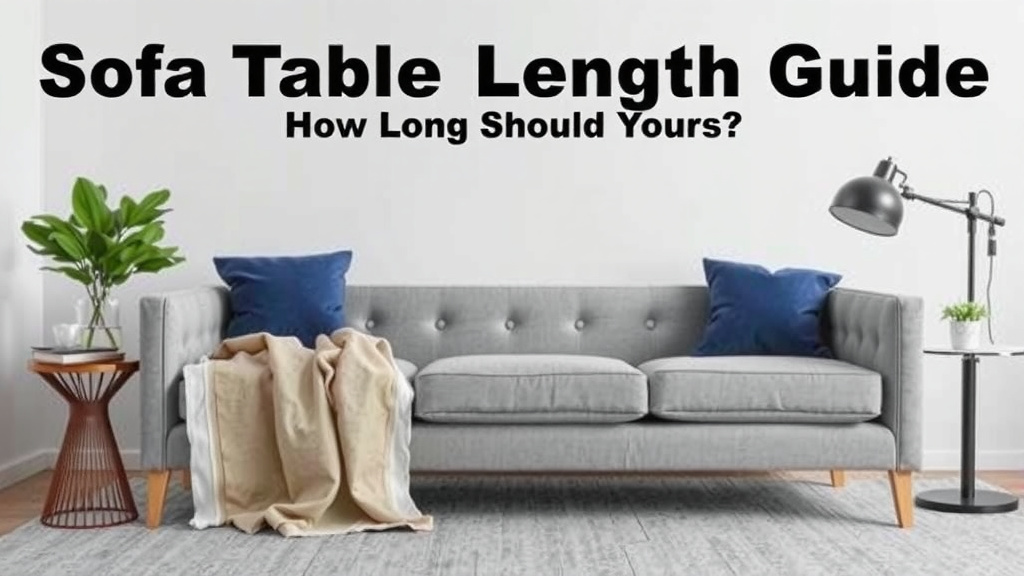
Sofa Table Length Guide: How Long Should Yours Be
The length of a sofa table can vary quite a bit, but you’ll most commonly find them between 48 and 72 inches long. This range typically fits well behind most standard-sized sofas. Think of your sofa table as a companion piece; its length should generally be about two-thirds to three-quarters the length of your sofa for a balanced look. You don’t want it to overpower your seating area or look too tiny.
When choosing a sofa table, consider your room’s proportions and your sofa’s size. A longer sofa might need a longer table to match. Even though common lengths exist, custom options are out there if you need a very specific fit. We found that proper sizing makes a big difference in how a room feels. Your sofa table should feel just right, not too big or too small.
- Sofa tables commonly range from 48 to 72 inches.
- Aim for a table that’s 2/3 to 3/4 the length of your sofa.
- Consider your room’s overall proportions.
- Custom sizes are available if needed.
- Proper sizing creates a balanced look.
Let’s dive into the typical dimensions and how to pick the perfect length for your space.
So, you’re wondering about the right length for your sofa table. It’s a common question because this piece of furniture can really tie your living room together, but only if it’s the right size. Let’s break down what usually works and how to figure out what’s best for your specific setup.
Choosing the Ideal Sofa Table Length
Finding the perfect length for your sofa table is all about achieving a sense of harmony and balance in your living space. It’s not just about fitting it behind your couch; it’s about how it looks and functions within the entire room. Think of it as a supporting actor to your sofa’s starring role.
Standard Sofa Table Dimensions: What’s Common?
Most often, you’ll find sofa tables falling into a specific size range. This range is a good starting point because it’s been developed over time to suit the average living room. We found that the most common lengths hover between 48 inches and 72 inches.
This 48-72 inch span covers a lot of ground. It’s designed to work with many different sofa sizes without looking out of place. A table at the shorter end of this spectrum, say 48 inches, might be perfect for a loveseat or a smaller sofa. On the other hand, a 72-inch table can comfortably sit behind a larger, longer sectional.
The Golden Rule: Sofa-to-Table Ratio
There’s a widely recommended guideline that many interior designers and furniture makers follow. It suggests that your sofa table’s length should be roughly two-thirds to three-quarters the length of your sofa. This isn’t a hard-and-fast rule, but it’s a great way to ensure a visually pleasing proportion.
Let’s say you have a sofa that’s 84 inches long. Using the two-thirds rule, your ideal table length would be around 56 inches (84 * 2/3 = 56). If you lean towards the three-quarters rule, you’re looking at about 63 inches (84 * 3/4 = 63).
Why this ratio? When your table is too short, it can look a bit lost. It might seem like an afterthought. Conversely, if it’s too long, it can overwhelm your sofa and the entire seating area. It might feel cramped.
Considering Your Sofa’s Specifics
Different types of sofas have different lengths. A standard three-seater sofa might be around 70-90 inches. A sprawling sectional could easily stretch to 120 inches or more. Even a cozy loveseat might only be 50-60 inches long.
You’ll want to measure your sofa carefully before you start shopping. Measure from the outside armrest to the other outside armrest. This measurement is key to applying that two-thirds to three-quarters ratio correctly. Don’t forget to account for any arms that might be wider or more rounded.
We found that many people overlook this simple measurement. But it’s a critical first step. It prevents you from buying a table that just doesn’t “fit” visually, even if it physically clears the space.
Factors Beyond the Sofa: Room Proportions Matter Too
While the sofa is your primary reference point, don’t forget about the room itself. How big is your living room? How much space do you have between the sofa and the wall, or between the sofa and other furniture?
Visual Weight and Room Scale
A large, sprawling room can often accommodate a longer sofa table without it looking too big. In this case, you might even go a bit longer than the standard ratio suggests, perhaps even matching the sofa’s length if you have ample space. This can create a grander, more unified feel.
On the flip side, a smaller room or a more compact living area calls for a more judicious choice. A shorter sofa table, or one that sits a bit closer to the sofa, might be better. You want to avoid making the room feel cluttered or the pathway behind the sofa too narrow.
Traffic Flow and Functionality
Think about how you’ll move around your living room. Is there a main walkway behind the sofa? If so, you need to ensure your sofa table doesn’t obstruct this flow. A table that juts out too far can be a tripping hazard and just plain inconvenient.
We found that many people use the space behind the sofa for more than just decorative purposes. It can be a spot for lamps, books, or even a place to set down drinks. Consider what you’ll use the table for and how its length will impact that daily use. A longer table offers more surface area, which can be great for functionality.
The Console Table vs. Sofa Table Nuance
Sometimes, the terms “sofa table” and “console table” get used interchangeably. While they can be very similar, there’s a slight distinction. Sofa tables are specifically designed to go behind a sofa, often being a bit deeper than traditional console tables.
Console tables are often narrower and can be used in entryways, behind sofas, or against a wall. If you’re looking at console tables for behind your sofa, pay close attention to their depth. A console table that is too shallow might not offer enough surface area for lamps or decor, even if its length is appropriate.
When Standard Sizes Don’t Quite Fit: Customization Options
What if your sofa is an unusual length, or your room’s layout is unique? Don’t despair! Standard sizes aren’t the only option available.
The Appeal of Custom-Sized Tables
Many furniture makers offer custom sizing for their pieces. This allows you to get a sofa table made to your exact specifications. You can choose the precise length, depth, and even height. This is a fantastic solution for those with very large or very small sofas, or unusually proportioned rooms.
The main trade-off with custom furniture is often the cost and the lead time. It will likely be more expensive than an off-the-shelf item, and you’ll have to wait for it to be made. However, many find the perfect fit is worth the investment.
DIY Solutions for a Perfect Fit
For the handy among you, a DIY approach can also yield a custom-sized sofa table. With basic woodworking skills, you can build a table that perfectly matches your sofa’s dimensions and complements your decor. There are numerous online tutorials and plans available for inspiration.
Quick Checklist for Your Sofa Table Length Decision
To help you make the best choice, here’s a quick rundown of what to consider:
- Measure your sofa from armrest to armrest.
- Calculate your target table length (2/3 to 3/4 of sofa length).
- Assess your room’s overall size and scale.
- Consider traffic flow behind the sofa.
- Think about what you’ll place on the table.
- Explore custom options if standard sizes don’t work.
Conclusion
You’ve learned that the ideal sofa table length is more than just a number; it’s about creating visual harmony. Most tables fall between 48 and 72 inches, but the best fit is often two-thirds to three-quarters the length of your sofa. Remember to consider your room’s scale and how you use the space behind your couch.
Don’t feel limited by standard sizes – custom options can provide that perfect fit. By measuring your sofa and assessing your room, you’re well on your way to finding a sofa table that truly complements your living area. Your next step? Grab your measuring tape and start visualizing that balanced look!
Frequently Asked Questions
What if my sofa is longer than 72 inches?
If your sofa is longer than the typical 72-inch sofa table, you’ll definitely want to look beyond standard options. Many furniture makers offer custom sizing, allowing you to get a table made to your exact specifications. You could also consider using two smaller tables placed end-to-end.
Can a sofa table be the same length as my sofa?
Generally, we advise against a sofa table being the exact same length as your sofa. A table that’s too long can overwhelm the sofa and make the seating area feel cramped. Aiming for two-thirds to three-quarters the sofa’s length usually provides a much more balanced aesthetic.
How deep should a sofa table be?
While this article focuses on length, depth is important too. Most sofa tables are about 12 to 18 inches deep. This depth provides enough surface area for lamps or decor without protruding too far behind the sofa, which could interfere with traffic flow.
Should I consider the height of the sofa table?
Yes, height is another factor for balance. A sofa table should typically be the same height as your sofa or slightly shorter. This creates a cohesive line and ensures the table doesn’t appear to be overpowering your seating.
What if I have a small apartment and a small sofa?
For smaller spaces and loveseats, look for sofa tables on the shorter end of the common range, around 48 inches or even less. You might also find narrower console tables that work well behind a smaller sofa. Prioritize a table that doesn’t make your cozy space feel crowded.


![10 Best Colour Rug For Grey Sofa [2026]](https://hometopaccesories.com/wp-content/uploads/2026/09/10-best-colour-rug-for-grey-sofa-2026-featured-768x432.jpg)