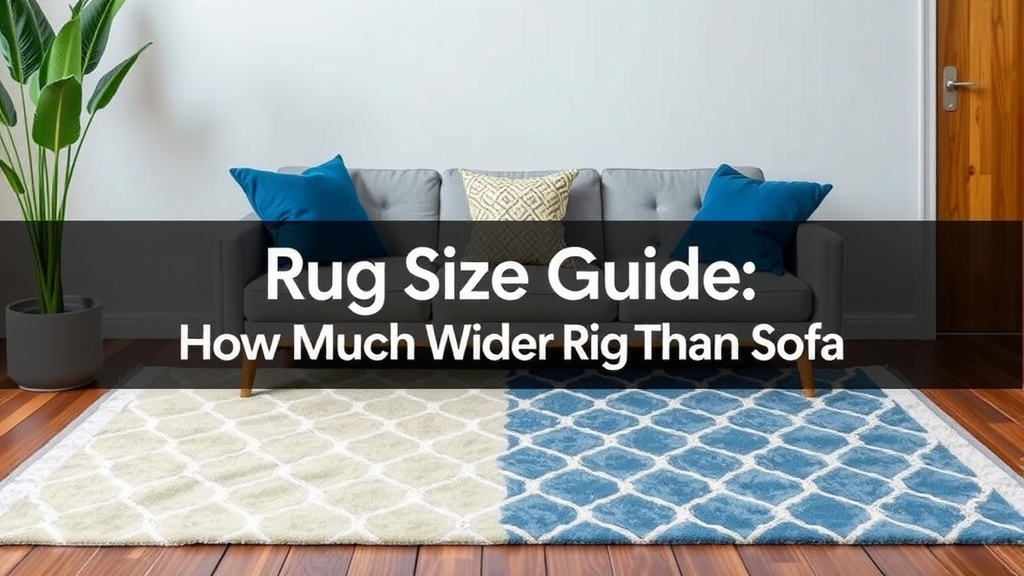
Rug Size Guide: How Much Wider Than Sofa
For a balanced living room, your rug should ideally be about 1 to 2 feet wider than your sofa on each side. This creates a visually appealing proportion. Getting this right makes your furniture grouping feel grounded and intentionally styled. A rug that’s too small can make your whole space feel off.
Many homeowners wonder about the perfect rug size. It’s not just about the sofa; consider your seating arrangement too. Many experts recommend that the front legs of all your seating furniture should rest on the rug. This pulls the room together nicely.
- Aim for 1-2 feet of rug extending past your sofa on each side.
- Ensure the front legs of your sofa and chairs sit on the rug.
- This creates a grounded, cohesive look.
- Avoid rugs that are too small – they can make a room feel choppy.
Let’s walk through exactly how to measure for your rug and achieve that perfect balance in your living room.
Getting the Rug Size Right Around Your Sofa
Finding the perfect rug size for your living room can feel a bit like a puzzle. You want your furniture to feel anchored, not like it’s floating in a sea of flooring. A common question is: how much wider should your rug be than your sofa? The general rule of thumb, which many designers follow, is to have the rug extend about 1 to 2 feet past your sofa on each side. This creates a pleasing visual balance and makes your seating area look intentional and complete.
Think of it like framing a picture. The rug acts as a frame for your furniture arrangement. Too small, and the picture looks cramped. Too big, and it overwhelms the subject. We want that sweet spot where your sofa and other seating pieces feel comfortably placed and grounded.
The Magic Measurement: Sofa Width vs. Rug Width
Let’s break down that 1-2 foot guideline. If your sofa is 7 feet long, you’re looking for a rug that’s roughly 9 to 11 feet long. This gives you that extra buffer on both ends. So, if your sofa is 84 inches (7 feet) wide, you’d aim for a rug that’s around 108 to 132 inches (9 to 11 feet) long. This ensures that when you’re standing back, the rug doesn’t look like an afterthought.
Why This Extra Space Matters
This extra width isn’t just for looks; it serves a purpose. It prevents the rug from looking like a postage stamp in the middle of your floor. It helps to define the seating area, especially in larger rooms. When you have this extension, it naturally draws your eye to the grouping of furniture. It tells your brain, “This is where the conversation happens.”
Many design experts agree that the rug should be wide enough to house the majority of your main seating furniture. This often means the front legs of your sofa, armchairs, and any ottomans should comfortably sit on the rug. Having just the sofa on the rug, with chairs floating off to the sides, can make the arrangement feel disconnected (Houzz). The 1-2 foot extension helps achieve this.
Beyond Just Sofa Width: Considering Your Whole Seating Area
While the sofa’s width is a major factor, it’s not the only one. You need to consider your entire seating arrangement. Do you have a loveseat and two armchairs? Or perhaps a sectional? The rug needs to be large enough to accommodate all these pieces in a cohesive way. The goal is to have a rug that feels like the foundation for your entire living space.
The “Front Legs On” Rule
A widely accepted guideline from interior designers is the “front legs on” rule. This means the front legs of your sofa and any chairs should be resting on the rug. This connects the pieces of furniture to the rug and to each other. It creates a unified look, preventing furniture from appearing as if it’s about to drift away.
Imagine walking into a room. If only the center of your sofa is on the rug, and the legs of the chairs are on bare floor, it can feel a bit disjointed. When those front legs are on the rug, it visually pulls everything together. It makes the entire seating cluster feel more substantial and deliberately arranged. This is key for a well-styled room.
Sectionals and Other Layouts
Sectionals can be a bit trickier. For an L-shaped sectional, the rug should ideally be large enough to extend beyond both arms of the “L.” The same 1-2 foot rule generally applies. If you have a large U-shaped sectional, you might need a very generous rug, or even consider two rugs layered or placed side-by-side to cover the area effectively. We’ll discuss more about sectional rug placement later.
Measuring Your Space: A Practical Approach
Before you buy, it’s always best to measure. Grab your measuring tape and a pad of paper. Start by measuring the width of your sofa. Then, measure the depth of your sofa. You’ll want your rug to be wider than the sofa, as we’ve discussed, but also deep enough to accommodate at least the front legs of any chairs facing the sofa.
Visualizing the Space with Painter’s Tape
A fantastic trick is to use painter’s tape on your floor. Lay out the dimensions of the rug size you’re considering. This allows you to physically see how much space it will occupy. You can walk around it, place your furniture, and get a real feel for the scale. Does it feel too big? Too small? This step is a real game-changer and prevents costly mistakes.
When using tape, remember to account for the 1-2 foot extension on each side of your sofa. If your sofa is 8 feet long, and you’re aiming for an 11-foot rug, mark out an 11-foot length. Then, center your sofa within that taped area to see how much space is left on either end. This visual check is incredibly helpful.
Common Rug Size Mistakes to Avoid
We’ve all seen it – a tiny rug drowning in a large living room, or a rug that’s just a bit too short for the sofa. These aren’t just minor style faux pas; they can actually make your room feel smaller and less cohesive.
The Too-Small Rug Problem
The most common mistake is choosing a rug that is too small. This happens frequently when people buy based on a standard rug size without measuring their space or considering their furniture. A rug that is too small often means that only the coffee table sits entirely on it, with the sofa and chairs floating around it on the bare floor. This creates a disjointed feel. It’s like serving a tiny appetizer on a giant platter – it just looks awkward.
Research indicates that a rug that is too small can actually make a room feel less spacious and more cluttered. It fails to define the area properly. We want our rugs to ground our furniture, not look like they’re lost at sea. Aiming for a rug that allows at least the front legs of your sofa and chairs to rest on it will prevent this common pitfall.
The “Just the Coffee Table” Rug
Sometimes people opt for rugs that are only large enough for the coffee table and maybe the very front edge of the sofa. This is a definite no-go if you want a balanced look. This size typically only works for very small apartments or studio setups where space is extremely limited. Even then, you might consider a slightly larger option if possible.
When you’re measuring, think about the overall footprint of your seating arrangement. If you were to draw a rectangle around your sofa and the closest chairs, what would the dimensions of that rectangle be? Your rug should aim to cover a good portion of that, ideally with space around the edges.
Rug Sizes Based on Sofa Lengths: A Quick Guide
To help you visualize, here’s a rough guide based on common sofa lengths. Remember, this is a starting point, and your specific furniture layout might require adjustments.
| Sofa Length | Ideal Rug Length (Wider than Sofa) | Consideration |
|---|---|---|
| 6 Feet (72 inches) | 8-9 Feet (96-108 inches) | Ensure front legs of chairs fit. |
| 7 Feet (84 inches) | 9-10 Feet (108-120 inches) | Good for most standard living rooms. |
| 8 Feet (96 inches) | 10-11 Feet (120-132 inches) | Provides ample space around larger sofas. |
| Sectional Sofa | 10×14 Feet or larger, or two layered rugs | Size depends heavily on sectional dimensions. |
This table illustrates how the rug size should grow with your sofa. The goal is always to have that extra 1-2 feet on either side of the sofa’s longest dimension. For larger or oddly shaped furniture, custom rug sizes or clever layering might be your best bet. We found that many homeowners struggle to find off-the-shelf rugs that perfectly fit large sectionals, so don’t be discouraged if you need a custom solution or creative approach.
Checklist for Your Perfect Rug Fit
Ready to find your ideal rug? Here’s a quick checklist to keep you on track:
- Measure your sofa’s width and depth.
- Measure the space around your seating area.
- Ensure the rug will be 1-2 feet wider than your sofa.
- Confirm the front legs of all main seating pieces will fit on the rug.
- Use painter’s tape to visualize the rug’s size on your floor.
- Consider your room’s overall scale and layout.
Conclusion
You’ve now got a clear picture of how to size your living room rug. Remember, the 1-2 foot extension past your sofa isn’t just a suggestion – it’s key to a balanced and inviting space. This simple guideline helps ground your furniture and defines your seating area, making your room feel cohesive and intentionally designed. By measuring carefully and using visual aids like painter’s tape, you can avoid common mistakes and achieve that perfectly styled look. Now, go forth and make your living room truly shine!
Frequently Asked Questions
What if my sofa is an unusual shape, like a curved sofa?
For curved sofas, measure the longest point of its width. Then, apply the same 1-2 foot extension rule from that measurement. You’re still aiming for that balanced, grounded look by extending the rug beyond the sofa’s extremities.
Can I use a rug that’s the same width as my sofa?
It’s generally not recommended. A rug the same width as your sofa can make the furniture arrangement look cramped or unfinished. The extra 1-2 feet on each side creates visual breathing room and integrates the rug better with the surrounding space.
Does the rug size rule change for apartments or smaller rooms?
In smaller spaces, you might have less room to extend the rug by 1-2 feet on each side. The key is still to have at least the front legs of your sofa on the rug. Prioritize connecting the furniture pieces over the exact extension measurement if space is very limited.
What if my sofa is very deep? Does that affect rug width?
Sofa depth primarily influences the rug’s depth, ensuring it reaches far enough back to anchor chairs or offer a comfortable landing. While the 1-2 foot rule focuses on width for sofa overhang, you still want the rug to be deep enough to accommodate furniture legs for a connected feel.
How do I know if my rug is too big?
A rug that’s too big can overwhelm the room. If the rug extends too far past your seating area, making it difficult to place other furniture or navigate around the space, it might be too large. Ideally, there should still be some bare floor visible between the rug’s edge and the walls.
![10 Best Article Sofa [2026]](https://hometopaccesories.com/wp-content/uploads/2026/08/10-best-article-sofa-2026-featured-768x432.jpg)
![10 Best Brand Of Chesterfield Sofa [2026]](https://hometopaccesories.com/wp-content/uploads/2026/08/10-best-brand-of-chesterfield-sofa-2026-featured-768x432.jpg)
![10 Best Compressed Sofa In A Box [2026]](https://hometopaccesories.com/wp-content/uploads/2026/09/10-best-compressed-sofa-in-a-box-2026-featured-768x432.jpg)