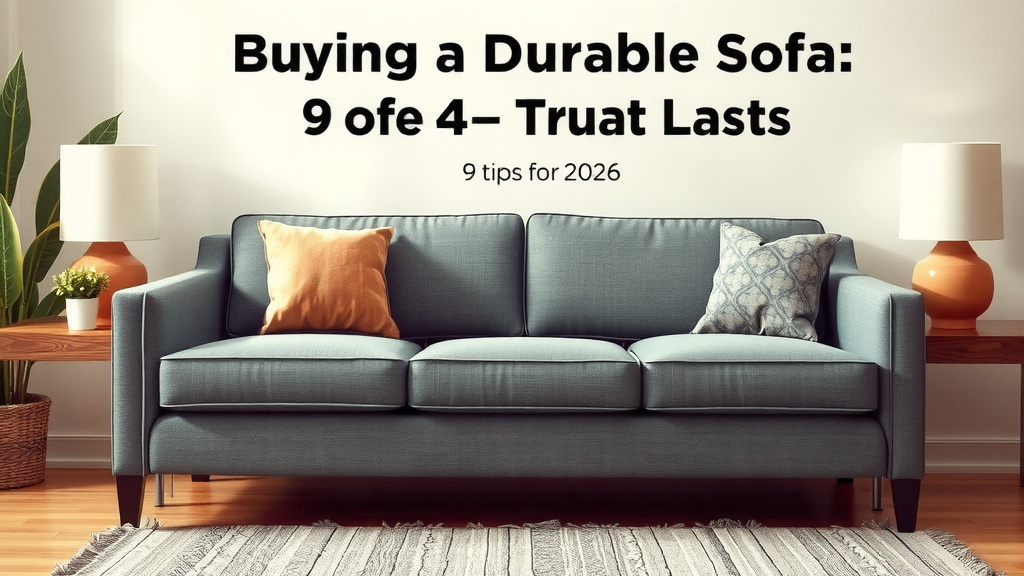
How to Buy a Sofa That Lasts: 9 Tips for 2026
Buying a sofa that will last starts with three things: a solid frame, quality cushions, and stain-resistant fabric. Choose hardwood frames, high-density foam, and durable upholstery, and your sofa can comfortably last 10 to 15 years. Skip the cheap shortcuts, and you’ll be shopping again in three.
Here’s the truth: most sofas don’t wear out because of style. They fall apart because of weak frames, low-density foam, and flimsy stitching. We researched what furniture makers and upholstery experts actually recommend, and the good news is you don’t need a designer budget to get a couch that holds up.
So what should you actually look for when you’re standing in a showroom (or scrolling at midnight)?
- Check the frame first. Kiln-dried hardwood beats particleboard every time.
- Test the cushions. High-density foam keeps its shape for years.
- Pick fabric wisely. Performance fabrics and tight weaves handle kids, pets, and spilled coffee.
- Look at the joins. Corner blocks and dowels beat staples and glue.
- Ask about the warranty. A confident maker stands behind their work.
Below, we walk you through each step so you can pick a sofa you’ll love for years, not one you’ll regret by next Thanksgiving.
Buying a Durable Sofa: What Really Matters
The short answer: a sofa that lasts is built from the inside out. Frame first, cushions second, fabric third. If you shop in that order, you’ll avoid the pretty couches that sag within a year.
Think of it like buying a house. You wouldn’t pick one based on paint color alone. Same rule applies here. Let’s walk through each layer, starting with the part you’ll never see.
The Frame: Your Sofa’s Skeleton
Everything starts here. We found that most early sofa failures trace back to a weak frame, not worn fabric. Once the frame twists or cracks, nothing else matters.
Look for kiln-dried hardwood like oak, ash, or beech. Kiln-drying removes moisture, so the wood won’t warp or crack over time. Many experts say kiln-dried hardwood frames are worth the extra cost.
Here’s a quick test you can do in any showroom. Lift one front corner of the sofa a few inches off the floor. If the opposite front leg stays down, the frame is likely solid. If the whole side lifts and wobbles, walk away.
Joints and Joinery
How the pieces connect tells you a lot. The best frames use wooden dowels, corner blocks, and double screws. These hold tight for decades.
- Wooden dowels: strong and time-tested.
- Corner blocks: add rigidity where stress is highest.
- Metal brackets: fine as a supplement, not the main support.
- Staples and glue alone: a red flag. Cheap shortcuts.
If the salesperson can’t tell you how the frame is joined, that’s an answer too.
Cushions and Foam: Where Comfort Meets Longevity
Ask one question: what’s the foam density? High-density foam, rated around 1.8 pounds per cubic foot or higher, keeps its shape for years. Lower-density foam flattens fast, like bread left out overnight.
Sit the way you actually sit at home. Not politely on the edge. Sink in. Then stand up and watch the cushion. A good one regains its shape within seconds.
Foam, Down, or a Blend?
| Fill Type | Comfort | Lifespan | Maintenance |
|---|---|---|---|
| High-density foam | Firm, supportive | Long | Low |
| Foam-and-down blend | Soft with support | Medium-long | Fluff weekly |
| All down/feather | Luxuriously soft | Short without care | Constant fluffing |
| Low-density foam | Okay at first | Short | None (it just dies) |
For most families, high-density foam or a quality blend is the sweet spot. Many experts note that down-wrapped foam cushions give you softness without daily maintenance.
Choosing Upholstery That Survives Real Life
Fabric is where looks and durability collide. The best choice depends on your household. Kids and pets? Go tough. Quiet apartment? You have more freedom.
Check the double rub count if the tag lists one. It measures how many back-and-forth abrasions the fabric survives in testing. Anything above 25,000 double rubs handles daily family use well.
Best Fabrics for Busy Households
We found that these upholstery types earn consistent praise from furniture professionals:
- Performance fabrics: engineered to resist stains and fading. Spilled juice beads up and wipes off.
- Tightly woven microfiber: dense weave resists snags from claws.
- Leather: ages well and cleans easily, though it can scratch.
- Canvas and denim weaves: rugged, casual, affordable.
Skip delicate fabrics like silk or chenille if a toddler lives in your house. You already know how that story ends.
Pattern vs. Solid Colors
Clever but true: a heathered or patterned fabric hides small stains better than a flat solid. If you love light colors, look for performance versions with stain treatments instead of raw linen.
Construction Details That Separate Good from Great
Once the big three are covered, the small stuff tells you who actually cared while building your sofa.
- Reinforced corners: extra blocking where the arms meet the seat.
- Center legs: three legs wobble; five legs stay put.
- Serged and double-stitched seams: tight, straight, no loose threads.
- Spring systems: eight-way hand-tied springs are the gold standard; quality sinuous springs also perform well.
- Dust cover underneath: a clean, fitted bottom panel signals careful work.
Flip a corner of the skirt or peek underneath in the showroom. Nobody at the store will judge you. Honest.
Warranty, Care, and Your Pre-Purchase Checklist
A warranty is a maker’s confidence in writing. We found that reputable manufacturers typically offer at least a 10-year frame warranty, with shorter coverage on cushions and fabric. Read what’s actually covered, not just the number of years.
Care matters too. Vacuum cushions monthly, rotate them so they wear evenly, and keep the sofa out of direct sunlight so fabric doesn’t fade. Small habits, big payoff.
Your Quick Sofa-Buying Checklist
Take this with you. Screenshot it, print it, tape it to your phone.
- Kiln-dried hardwood frame you can verify by name.
- Joints secured with dowels or corner blocks, not just staples.
- Cushion foam density of 1.8 or higher.
- Fabric rated for 25,000+ double rubs (or performance-treated).
- Frame warranty of 10 years or more, in writing.
- Sit test passed: no wobble, fast cushion recovery.
One last thought. Measure your doorways before you buy. A sofa that can’t fit through the front door has a lifespan of exactly zero years, no matter how well it’s built.
Conclusion
A sofa that lasts isn’t luck. It’s a frame, cushions, and fabric chosen in the right order. We’ve covered how to spot kiln-dried hardwood, test foam density, and pick upholstery that survives real life. We also showed you the small construction details that separate careful makers from careless ones.
Here’s our best advice: take the checklist with you and ask the questions, even if they feel awkward. A good salesperson will welcome them. A bad one will dodge them, and that tells you everything you need to know.
Your next step? Measure your space and your doorways, then start shopping with confidence. You’ve got this.
Frequently Asked Questions
How much should I spend on a sofa that will last?
You don’t need a designer budget, but you should expect to pay more than rock-bottom prices. A well-built sofa usually starts around $1,000, with the best value in the $1,200 to $2,500 range. We found that spending a bit more upfront often costs less than replacing a cheap couch every three years.
Is it better to buy a sofa online or in a store?
In-store shopping lets you do the sit test and check construction details yourself, which we always recommend. Online buying works too, as long as the retailer clearly lists frame materials, foam density, and return terms. Look for free trial periods so you can test the sofa in your own home.
Are leather sofas more durable than fabric ones?
Quality top-grain leather can last 15 years or more and cleans up easily, which makes it a strong choice for many homes. The catch is that it can scratch and it costs more. A high double-rub performance fabric often matches leather’s lifespan at a lower price.
How do I know if a used sofa is worth buying?
Lift a corner to check for frame wobble, press the cushions to see if they bounce back, and inspect seams for sagging or loose threads. Sniff for odors that won’t come out. If the frame is solid and the foam still recovers, a used sofa can be a great deal.
When should I replace my sofa instead of repairing it?
If the frame is cracked, the arms wobble, or the springs poke through the seat, repair costs often approach the price of a new sofa. Sagging cushions alone are usually fixable with new foam inserts. Trust us: creaking, tilting, or visible frame damage means it’s time to shop.