How to Carry a Sofa Upstairs Without Damaging Walls
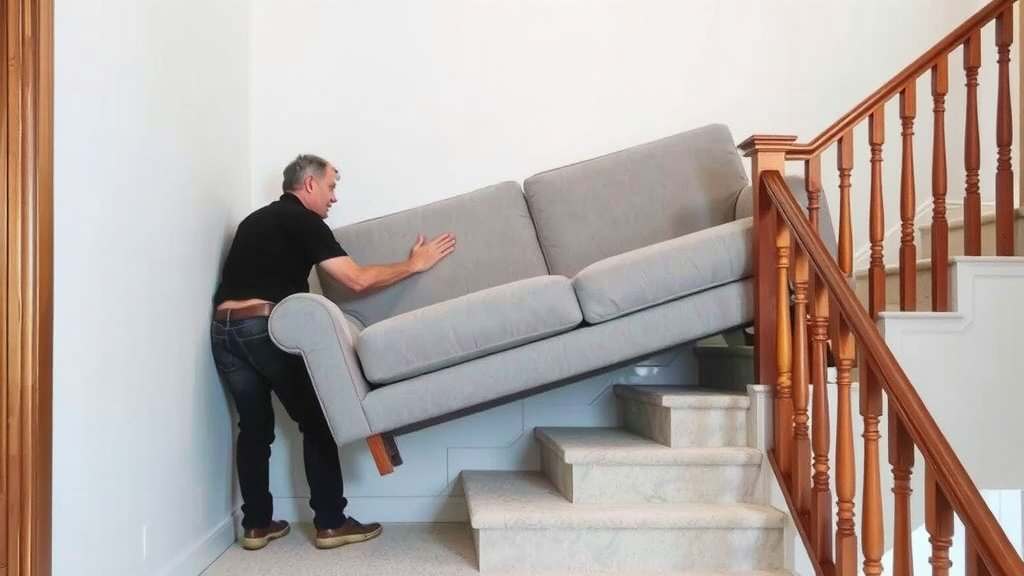
The easiest way to carry a sofa upstairs is to turn it on its side, tilt the top slightly forward, and move it up in a slow, angled “hook” motion around the banister. Working with two people helps a lot, and removing doors or cushions first gives you extra room. It sounds tricky, but with the right angle and a little patience, most sofas fit.
Here’s the thing, though: not every sofa will squeeze through. Sofas wider than your stairwell, tight spiral staircases, and awkward turns can turn a simple move into a frustrating puzzle. We researched what professional movers actually do, and we found that measuring first saves more headaches than any lifting trick. Before you hoist anything, you’ll want to know your sofa’s width, your doorway clearance, and the angle of your stairwell turn.
- Measure your sofa, doorway, and stairwell before lifting anything.
- Remove cushions, legs, and even door frames if you need extra space.
- Carry the sofa on its side or end, not flat.
- Use the “hook” method to pivot around banisters and corners.
- Protect walls and banisters with blankets or moving pads.
Below, we break down everything you need to know about getting your sofa upstairs without scratching walls, pinching fingers, or giving up and sleeping on it in the hallway. Let’s walk through it step by step.
Getting a Sofa Up the Stairs the Smart Way
The smart way to move a sofa upstairs is simple: measure first, strip the sofa down, then carry it on its side using a slow pivot at every turn. Rushing is what turns a 20-minute job into a two-hour hallway standoff. We found that movers who plan for about 15 extra minutes of prep rarely regret it.
Measure Everything First
Grab a tape measure before you touch the sofa. This one step prevents most stuck-sofa disasters. Measure three things: the sofa, the doorway, and the tightest part of your stairwell.
Here’s a quick reference to keep on your phone while you measure.
| What to Measure | Where | Why It Matters |
|---|---|---|
| Sofa length | Arm to arm, at the widest point | Tells you if it can ever fit flat |
| Sofa depth | Front to back | Becomes your working width on its side |
| Sofa height | Floor to tallest point | Matters when standing it on end |
| Stairwell width | Narrowest point, wall to wall | Your hard limit for anything |
| Turn clearance | At landings and banister curves | Where most sofas get stuck |
Many standard sofas run about 6 to 8 feet long, but a deep sectional can be wider than your stairwell no matter how you angle it. If your sofa’s depth is bigger than your stairwell width, you’ll need to carry it on its end instead.
Prep the Sofa and Your Path
Now clear the runway. Take off the cushions and set them aside. If the legs unscrew, remove those too; you’d be surprised how much clearance four wooden feet can steal.
Next, look at the route itself. Can you take a door off its hinges? Removing an interior door can add nearly 2 inches of clearance, which is often the difference between fit and no-fit. Lay moving blankets or old towels along the banister and any tight corners. Our guide to getting a sofa through a doorway covers tilt angles and when removing the door helps.
Also tape down loose rugs and move the dog to another room. A curious pet underfoot on a staircase is a recipe for a sprained ankle.
Lifting Techniques That Actually Work
The two methods pros rely on are the hook technique and the end-up carry. Both keep the sofa angled so it clears the banister instead of fighting it.
The Hook Method Around Corners
Think of the hook method like a fish hook catching a current. You tilt the sofa so the top end leads, then swing it around the banister post in one smooth arc.
Here’s how it works in practice:
- Stand the sofa on its side, with the bottom facing up the stairs.
- The person at the bottom guides; the person on top pulls and steers.
- Tilt the top of the sofa slightly forward, over the steps.
- At the turn, hook the bottom end around the banister post while the top swings wide.
- Move in small steps and stop the moment anything binds.
Never force it. If the sofa pinches against a wall, back up an inch and try a different angle. Forcing it just chews up your paint and your patience.
Going Vertical: The End-Up Carry
For tight spiral stairs or narrow turns, stand the sofa straight up on one end, like a surfboard. This shrinks its footprint dramatically and lets it thread through gaps a flat or sideways sofa never could.
One warning: a sofa standing on end is tippy. Keep a hand on it at all times, and have your spotter ready to catch a lean. Sectionals and sofas with attached headrests may not balance well this way, so test it on flat ground before you commit on the stairs.
Protect Your Body While You Lift
A sofa can weigh anywhere from 60 to 150 pounds, and stairs make every pound feel heavier. Your back is the tool most at risk here, so treat it kindly.
Safety guidance from the CDC’s National Institute for Occupational Safety and Health points to keeping loads close to the body and avoiding twisting while carrying. On a staircase, that means facing the sofa squarely, not turning your torso to chat with your partner mid-step.
Lift With Your Legs, Not Your Back
You’ve heard it a hundred times because it’s true. Bend at the knees, keep your back straight, and let your leg muscles do the work. The Mayo Clinic notes that poor lifting posture is one of the most common causes of lower back strain, and stairs amplify every mistake.
Two more tips we found in every mover’s playbook: wear shoes with real grip, and keep your fingers on top of the frame, never underneath. A sofa slamming down on trapped fingers is a trip to the ER you don’t want.
Pad the Walls and Banister
Before you lift anything, drape moving blankets over the banister and any corner the sofa will swing past. Painter’s tape holds them in place without ruining paint.
Skimp here and you’ll trade a five-minute prep step for a weekend of touch-up paint. Trust us, the math doesn’t favor the lazy route.
Work as a Team, Not Against Each Other
Two people can move most sofas upstairs. Three is even better when there’s a landing turn involved. The key is communication, not muscle.
Pick one person to call the moves. “Step,” “stop,” “tilt left,” that sort of thing. When both people push and pull on their own schedule, the sofa jerks, binds, and pinches fingers. When one person directs, it glides.
OSHA’s guidance on team lifting stresses coordinated movement and clear signals, and honestly, the same rules apply in your living room as on a warehouse floor.
When the Sofa Simply Won’t Fit
Sometimes the answer is no. If your sofa’s deepest measurement beats your narrowest stairwell point by more than an inch or two, no amount of hooking will fix it. Rather than sawing the sofa in half in a fit of frustration (it happens more than you’d think), run through this checklist:
- Remove the legs, cushions, and any removable arms one more time.
- Try the end-up carry on the tightest turn.
- Check whether a window on a lower floor offers a better path, with a safe hoisting plan.
- Look for built-in entry points; some apartment buildings have removable window panels for exactly this reason.
- Measure whether a loveseat or apartment-size sofa would fit instead.
- Call a professional mover with stair-climbing straps and real experience.
Professional movers carry furniture straps, shoulder harnesses, and stair-climbing dollies that home moves rarely have. If your sofa is a $2,000 sectional, a $200 moving bill is cheap insurance.
Conclusion
Getting a sofa upstairs comes down to three things: measure before you lift, strip the sofa down, and move it on its side with a slow, controlled pivot. We found that most failed attempts happen when people skip the prep and try to muscle through. Remove the legs, pad the banister, and put one person in charge of calling the moves. If the math says it won’t fit, don’t force it — a professional mover with the right straps costs less than a damaged sofa or a strained back. Your next step? Grab a tape measure and check your stairwell’s narrowest point before you lift a thing.
Frequently Asked Questions
Can one person carry a sofa upstairs alone?
It’s possible for a small loveseat, but we don’t recommend it for a full-size sofa. Stairs take away your ability to brace, and one wrong lean can pin you against a wall. If you have no help, consider furniture sliders on landings and moving straps that let you rest the load between steps.
Will my sofa fit if it’s wider than the stairwell?
Probably not, but width alone isn’t the whole story. When you turn a sofa on its side or end, its depth becomes the measurement that matters. Check the sofa’s depth against the stairwell width — if there’s still no clearance, the sofa likely won’t make it.
What should I do if my sofa gets stuck on the stairs?
Stop moving immediately. Forcing a wedged sofa damages the fabric, the frame, and your walls. Back it up an inch, tilt it differently, and try the turn again slowly. If it stays wedged after two or three angles, you may need to take the sofa apart or call a pro.
Is it better to push or pull a sofa up the stairs?
Pulling from above is usually safer, because the person on the stairs’ top step can steer and stop the load. The person below acts as a spotter and guide. Never stand directly downhill from a sofa on the stairs — you want to be beside it, not under it.
How do I know when to call professional movers instead?
If your sofa is heavier than about 100 pounds, has a tight landing turn, or you’re working alone, calling movers is the smarter call. We found that pros with stair-climbing straps and shoulder harnesses handle in 30 minutes what takes DIY movers two hours. It’s worth the money for anything expensive or oversized.