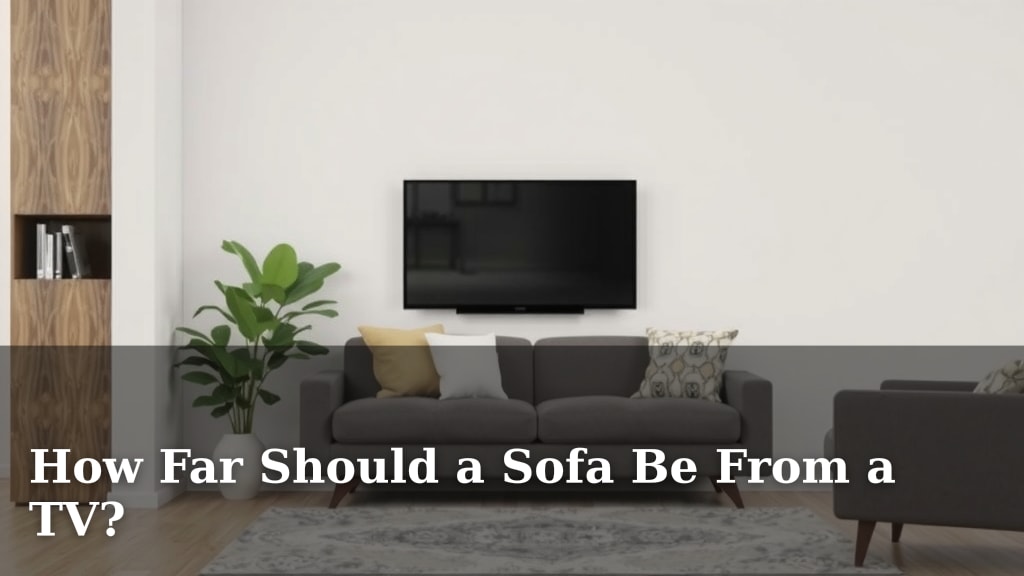
How Far Should a Sofa Be From a TV?
The ideal distance for your sofa from the TV is generally 1.5 to 2.5 times the diagonal screen size. This range helps you avoid eye strain and enjoy a truly immersive viewing experience. Getting this distance right is key to comfortable movie nights.
Many people wonder about the perfect viewing distance. It’s not just about cramming furniture into a room. We found that too close can cause discomfort. Too far, and you miss the details. Think about it as finding the sweet spot for both your eyes and your enjoyment. Comfort and clarity are the main goals here.
- The best sofa-to-TV distance is 1.5-2.5x the screen’s diagonal size.
- This range prevents eye strain and enhances your viewing pleasure.
- Consider your TV size and room dimensions for the perfect setup.
- Don’t forget about viewing angles for everyone in the room.
Ready to find that perfect spot for your couch? Let’s break down exactly how to measure and place your furniture for the ultimate home theater setup.
“`htmlFinding the Right Sofa-to-TV Viewing Distance
You’ve got your new TV, and you’re ready for movie nights. But where do you put the sofa? Getting this distance right is more important than you might think. It directly impacts your comfort and the overall viewing experience. We found that a common mistake is placing furniture too close to the screen.
Too close can lead to eye strain and a less immersive feel. The picture might seem overwhelming or distorted. On the flip side, placing the sofa too far away means you might miss important details. You’ll likely find yourself squinting to see what’s happening. The goal is to find that sweet spot where the picture feels just right.
The Science Behind the Ideal Distance
Experts often point to a simple formula for determining the optimal viewing distance. This formula takes into account the size of your TV screen. It’s based on how our eyes perceive images at different distances. Research suggests a range that is comfortable for most people.
Many professional recommendations center around the screen’s diagonal measurement. They suggest multiplying this diagonal by a factor. This simple calculation helps avoid both the too-close and too-far scenarios. It ensures you get the best picture quality without discomfort. This approach is widely accepted by home theater enthusiasts.
Calculating Your Perfect Viewing Spot
Let’s get down to the numbers. First, you need to know the diagonal screen size of your TV. This is usually measured in inches. You can typically find this information in your TV’s manual or on the manufacturer’s website. Once you have that number, it’s time for a little math.
A widely cited guideline recommends multiplying the screen’s diagonal by 1.5 to 2.5. So, if you have a 50-inch TV, your ideal viewing distance would be between 75 inches (50 x 1.5) and 125 inches (50 x 2.5). That’s about 6.25 feet to 10.4 feet. This range provides flexibility based on personal preference and room layout.
| TV Size (Diagonal) | Minimum Distance (1.5x) | Maximum Distance (2.5x) |
|---|---|---|
| 32 inches | 48 inches (4 ft) | 80 inches (6.7 ft) |
| 43 inches | 64.5 inches (5.4 ft) | 107.5 inches (9 ft) |
| 55 inches | 82.5 inches (6.9 ft) | 137.5 inches (11.5 ft) |
| 65 inches | 97.5 inches (8.1 ft) | 162.5 inches (13.5 ft) |
| 75 inches | 112.5 inches (9.4 ft) | 187.5 inches (15.6 ft) |
Remember to convert these inches into feet to make measuring your room easier. Most people find the middle of this range to be the most comfortable. This table gives you a quick reference for common TV sizes. It helps you visualize the space needed.
Understanding the THX Recommendation
For those seeking a truly cinematic experience, THX (a company known for setting audio and video standards) has specific recommendations. They suggest a slightly closer viewing distance for a more immersive feel. This often falls within the 1.2 to 1.6 times the screen diagonal.
This closer distance is designed to fill your field of vision more, much like a movie theater. It requires a higher resolution image to maintain clarity. For most standard HD or 4K TVs, sticking to the 1.5x to 2.5x range is safer and more comfortable for everyday viewing. You can certainly experiment with closer distances if your TV has a high enough resolution.
Considering Your Room’s Layout and Size
While the math provides a great starting point, your actual room dimensions play a huge role. You might have the perfect calculated distance, but if it means cramming other furniture or blocking walkways, it won’t work.
Walk around your living room. Imagine placing your sofa at the calculated distance. Is there enough space to move comfortably? Can you still open doors or access other areas of the room? You need to find a balance between the ideal viewing distance and practical room usage.
Viewing Angles for Multiple Viewers
What if you have a large sectional or multiple seating areas? The “ideal” distance might not be perfect for everyone. You want to ensure that most people in the room have a good view without straining their necks.
For wider seating arrangements, you might need to position the TV slightly further back. This helps maintain a reasonable viewing angle for those on the sides. Many experts suggest that no one should be sitting at an angle greater than 30 degrees from the center of the screen. This prevents distortion and discomfort.
Adjusting for TV Resolution (4K and Beyond)
The resolution of your TV is another factor to consider. Higher resolution TVs, like 4K and 8K models, have more pixels packed into the screen. This means you can sit closer without noticing the individual pixels.
With 4K TVs, you can often get away with sitting a bit closer than the standard formula suggests. Some recommendations for 4K suggest a range of 1 to 1.5 times the screen diagonal. This allows you to appreciate the incredible detail of high-resolution content. However, many still find the 1.5x to 2.5x range comfortable for extended viewing sessions.
Your Easy Checklist for Perfect Placement
Ready to find that sweet spot? Here’s a quick checklist to help you:
- Measure your TV screen diagonally in inches.
- Calculate your ideal range: Multiply diagonal by 1.5 and 2.5.
- Convert your range to feet for easier room measurement.
- Consider your room’s layout and traffic flow.
- Think about viewing angles for everyone seated.
- Test the distance with a movie or show to see how it feels.
Don’t be afraid to make small adjustments. What feels right for your eyes and your space is the most important factor. This formula is a guide, not a rigid rule. Your comfort is the ultimate goal.
“`
Conclusion
You’ve learned how to find the perfect sofa-to-TV distance. It’s a simple formula: 1.5 to 2.5 times your TV’s diagonal screen size. This range ensures comfort and clarity for all your viewing. Remember to consider your room’s layout and everyone’s seating positions. Don’t just rely on numbers; trust your eyes and your comfort.
Your ultimate goal is an enjoyable and strain-free viewing experience. So, go ahead and measure your space. Make those small adjustments needed to get it just right. Your home theater awaits!
Frequently Asked Questions
Is the 1.5x to 2.5x rule always the best?
This range is a great starting point based on research for comfortable viewing. However, personal preference plays a big role. Some people might prefer to sit slightly closer or further away depending on the content and their eyesight.
Can I sit closer to a 4K TV?
Yes, with 4K and higher resolutions, you can often sit closer. The increased pixel density means you’re less likely to see individual pixels. You might find a range of 1 to 1.5 times the screen diagonal comfortable for 4K content.
How do I account for a large sectional sofa?
For wider seating, you may need to position your TV a bit further back. This helps maintain better viewing angles for people sitting at the ends. Aim to keep everyone within about a 30-degree viewing angle from the center of the screen.
What if my room is small and the calculated distance is too far?
In smaller rooms, you might need to compromise slightly. Try to get as close to the lower end of the recommended range as possible. Prioritize having enough space to walk around comfortably and avoid feeling cramped.
Does the height of the TV matter for viewing distance?
While not directly part of the distance formula, TV height is important for comfort. The center of the screen should generally be at or slightly below eye level when you’re seated. This prevents neck strain during long viewing sessions.